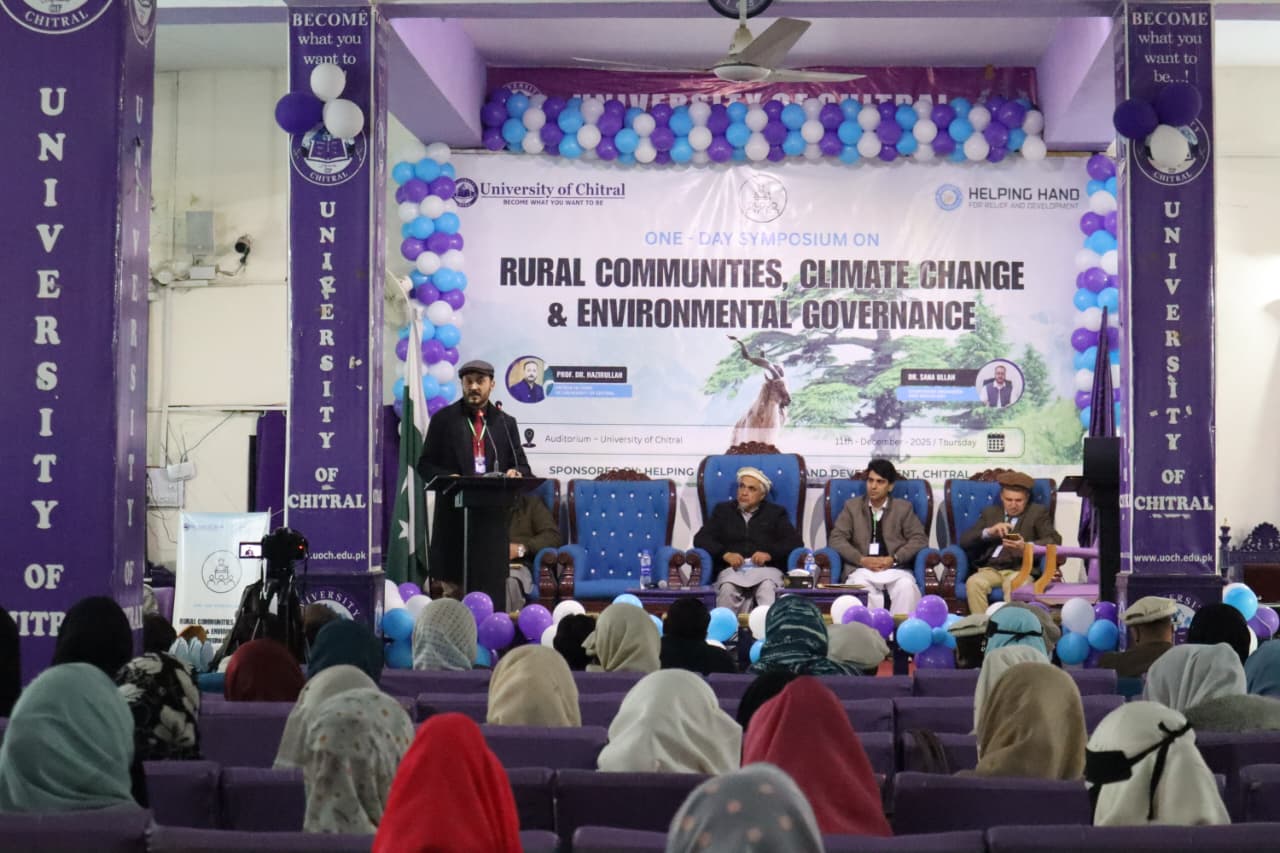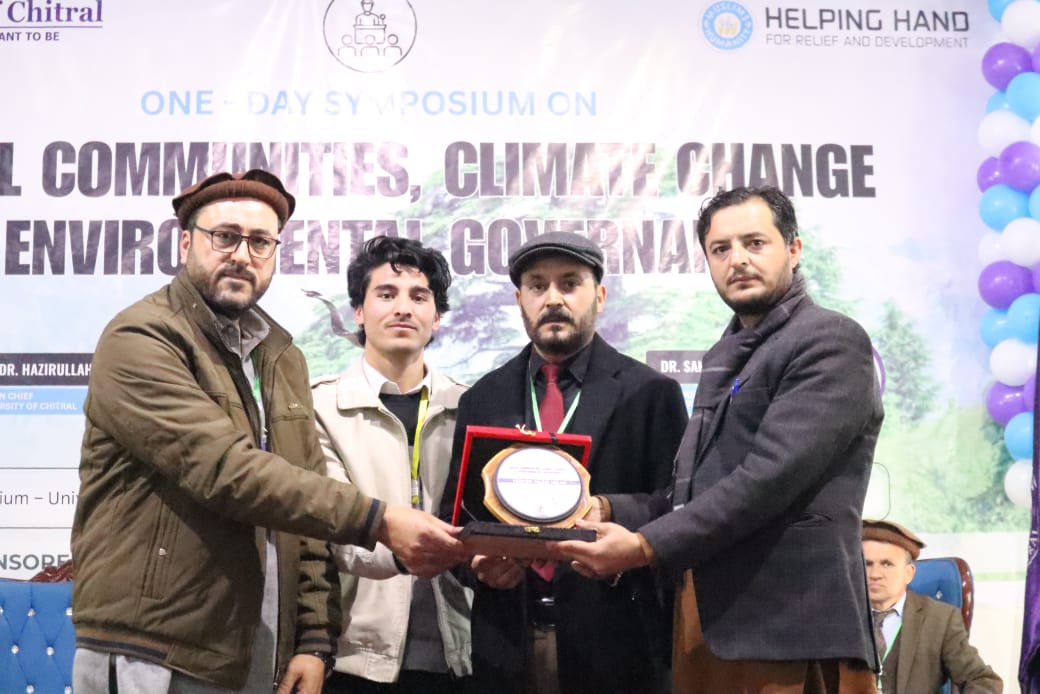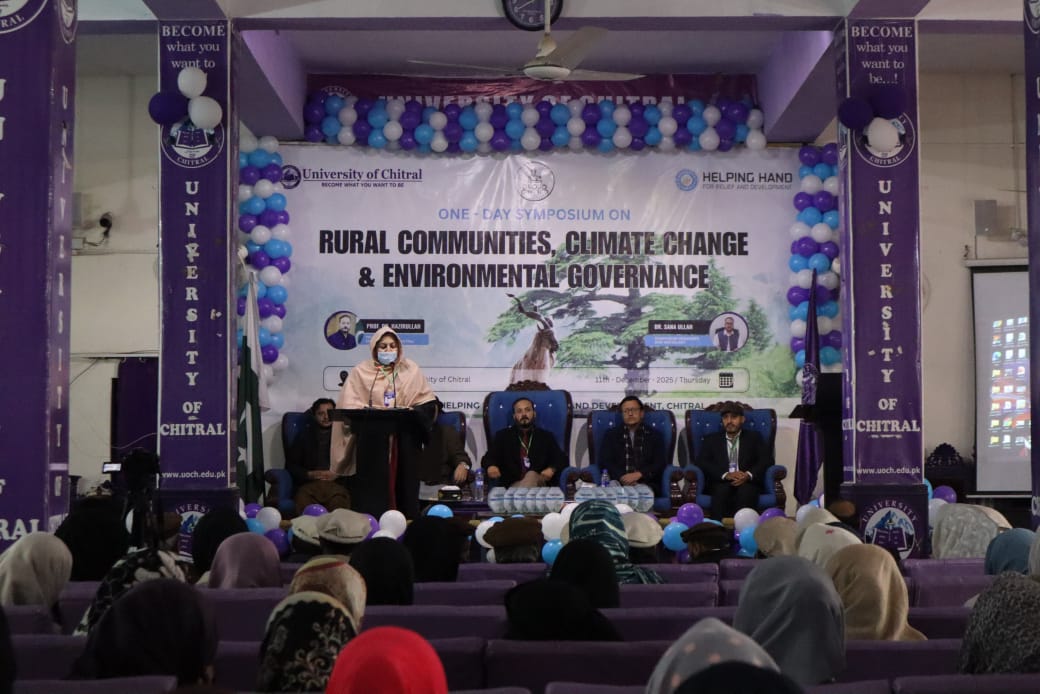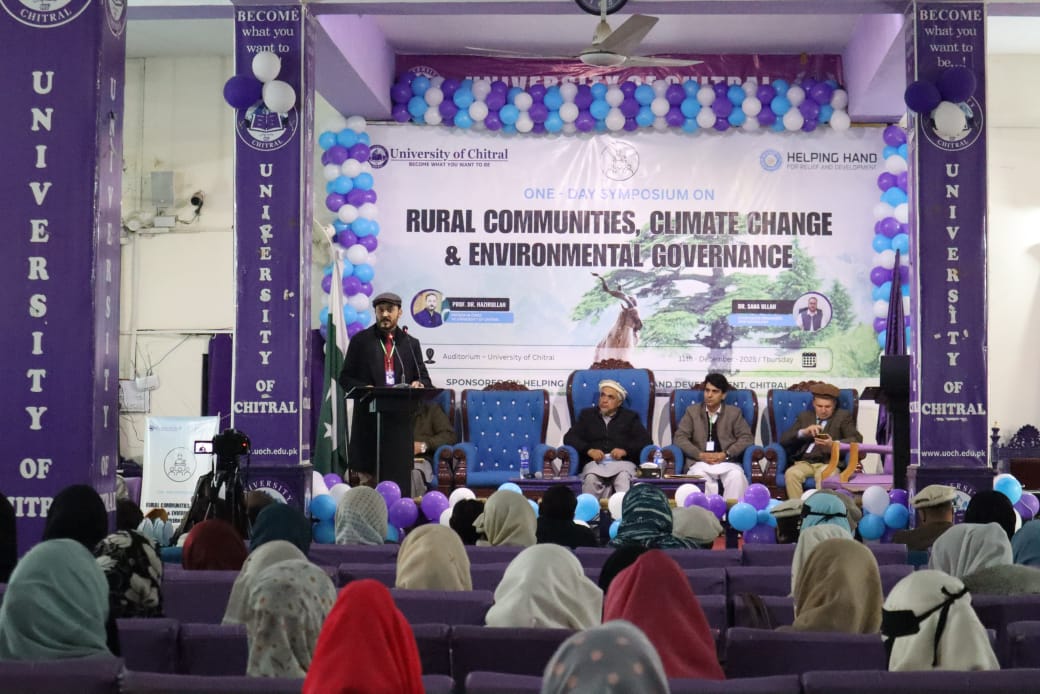
The University of Chitral
in Collaboration with Helping Hand for Relief and Development (HHRD) Organized
a successful one-day symposium on the theme “Rural Communities, Climate
Change, and Environment Governance” on 11th December 2025. The
volunteer of the Youth Empowerment Club (YEC), University of Chitral, Academic
scholars, development practitioners, civil society organizations, NGOs
representatives and students participated in the seminar. The symposium brought
together research community, academia, relevant line departments, NGOs/ civil
society organizations, general community, and students for dialogue on the
issue of climate change. The symposium also aims to create awareness about the
impact of climate change on precipitation patterns, agriculture, social interaction, lives, and peaceful
coexistence of communities in northern areas of Pakistan, to promote
environmental governance through inclusivity and mainstream local communities
in environment related planning and decisions, thus paving the way for
sustainable and inclusive development, thereby contributing to national climate
policy of Pakistan and global Sustainable Development Goals (SDGs)..
Mr.
Hamid Ahmad Mir, Coordinator at WWF, delivered a presentation on Making
Resilient Communities in the Wake of Climate Change: SDGs and Local Insights.
He emphasized the importance of community-level strategies, environmental
awareness, and the integration of Sustainable Development Goals for building
resilience among vulnerable populations of the northern areas. He also
highlighted the importance of research on the issue and informed the forum
about the integrated nature of SDGs.
Dr.
Sana Ullah, Head of the Department of Sociology and Principal Organizer of the
Symposium, shared his valuable viewpoints on Climate Change and Rural
Communities: The Question of Sustainable and Inclusive Development. His
address highlighted the social dimensions of climate challenges and presented a
historical overview of population growth, resource exploitation, capitalist
market economy and the issue of climate change. He further described the
concept of inclusive and sustainable development in the rural context. He
suggested collaboration and synergies among academia, civil society, donor
agencies, academia and community to positively respond to the issue of climate
change. At the end he also told that respecting the environment is necessary
for protecting the future generation.
Dr.
Shah Fahad Ali Khan, Lecturer of Botany and wildlife ecologist and researcher,
shed light on environmental changes and their implications for biodiversity and
wildlife conservation. He also informed the participants about the endangered
species in the Hindu Kush Range and presented figure and facts about the impact
of climate change on the rural communities.
Dr.
Sajjad Hussain, Head of the Department of Political Science and Co-Organizer of
the Symposium, presented his talk on Climate Change and Environmental
Governance: Perspectives and Implications. He discussed the different
policies and models of related to climate change in Pakistan and at global
level. He further highlighted that the best model for tackling the issue
effectively is a bottom to up model of governance. He elaborated the concepts
of environmental governance and said that policy frameworks and governance
mechanisms are essential for effective climate action.
The
Penal Discussion was an intellectually stimulating session comprised of experts
from diverse specialized backgrounds including Prof. Hisam Uddin (rtd)
Professor of Geography, Dr. Azizullah Jan, Assistant Professor of sociology,
Mr. Basharat Hussain, Lecturer of political Science, Mr. Hafizullah Lecturer of
Botany, Mrs. Uzma Sher, Lecturer of Botany and Mr. Hamid Ahmad Mir, Coordinator
WWF. Mr. Salim Uddin, Coordinator for Muslim Aid Chitral. The panelist from
various academic and professional backgrounds exchanged views on dimensions of
climate change, SDGs, climate resilience, policy gaps, impacts of climate
change on rural communities, and the role of youth and institutions in tackling
the issue in a sustainable manner. An engaging Q&A session also held after
the penal discussion that encouraged active participation from students and
attendees. Mr. Salim Uddin, Coordinator for Muslim Aid Chitral, performed the
moderation during the session.
Mr.
Shuja ul Haq, District Coordinator for HHRD Chitral, delivered a comprehensive
presentation on Climate Change and HHRD Community-Based Disaster Risk
Reduction Interventions. He discussed HHRD’s ongoing initiatives aimed at
minimizing climate-induced risks through community engagement and capacity
building. He also shared the commitment and interventions of HHRD for promoting
community resilience under the CBDRM component and highlighted the working
methodologies and success of the program.
The
symposium concluded with the closing remarks by Prof. Dr. Hazir Ullah, Vice
Chancellor of the University of Chitral. The Vice
Chancellor, in his address, drew a comparison between shifting weather patterns
and his own personal observations of climate change in Chitral. He highlighted
the devastating impacts of global warming experienced across Khyber Pakhtunkhwa
this year. Citing UN data, he noted that approximately 15
Billion trees are cut down each year, while only 2 Billion are planted, leading to a significant
rise in CO₂ emissions and elevating the
risk of deforestation. He stressed that humans are primarily responsible for
global warming and emphasized that it is our collective responsibility to take
urgent measures to control and mitigate its effects.. He said that it is collective responsibility of academia,
institutions, and youth to address the menace of climate change and foster
sustainable development. The Vice Chancellor also appreciated the efforts of
the organizer, Youth Empowerment Club (YEC) and Helping Hand for Relief and
Development (HHRD) for organizing a fruitful Symposium.